
Published: August 27, 2026

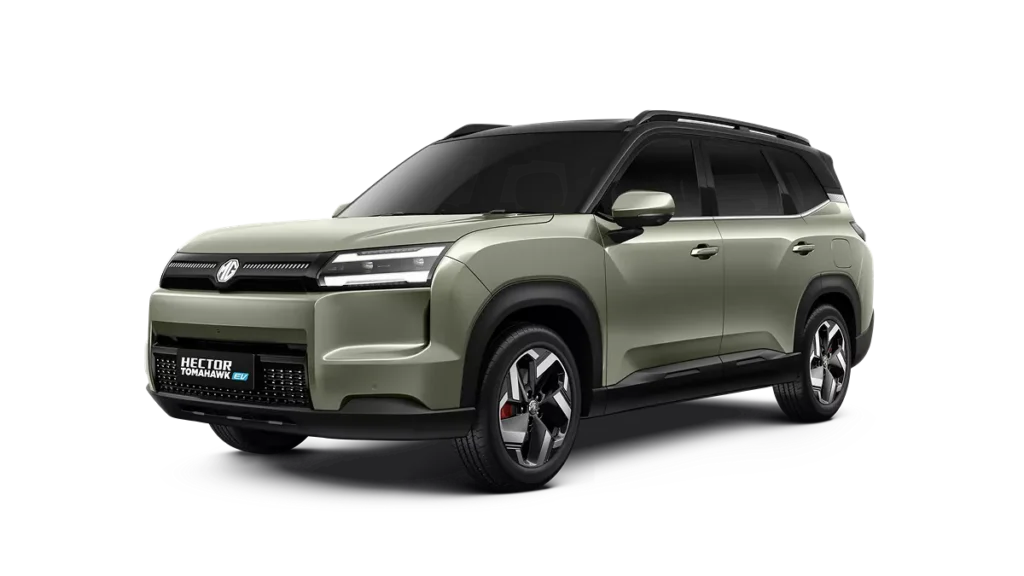
MG Hector Tomahawk price starts at ₹19.49 lakh, following its India launch on August 26, 2026 – and rather than a single model, it arrived as a full lineup: both a fully electric (EV) version starting at ₹19.49 lakh and a plug-in hybrid (PHEV) version at ₹25.69 lakh (both ex-showroom). This isn’t a facelift or a variant update to the existing Hector; it’s a completely new model built on MG’s new ADAPT platform, designed from the ground up to support EVs, plug-in hybrids, strong hybrids, and range-extender powertrains — and the Tomahawk PHEV specifically marks India’s first mainstream plug-in hybrid SUV.
Here’s everything confirmed at launch — price, specs, features, and how it stacks up against the competition.
MG Hector Tomahawk Price and Variants
MG has launched the Hector Tomahawk with two distinct powertrains, each with its own variant lineup:
Hector Tomahawk EV:
- Excite (7-seat): ₹19.49 lakh
- Exclusive (7-seat): ₹21.99 lakh
- Essence (7-seat): ₹23.49 lakh
- Essence (5-seat): ₹22.99 lakh
Hector Tomahawk PHEV:
- Starts at ₹25.69 lakh (7-seat only)
MG is also offering a Battery-as-a-Service (BaaS) option on both powertrains — you pay a lower upfront price and a per-km battery rental fee instead of owning the battery outright. This drops the EV’s entry price to ₹13.99 lakh + ₹4.90/km, and the PHEV’s to ₹21.79 lakh + ₹3.20/km. It’s a genuinely useful option if you want to lower the upfront cost and aren’t worried about long-term battery ownership.
(All prices ex-showroom; on-road prices will run higher depending on your state.)
What’s Under the Hood
The PHEV combines a 1.5-litre petrol engine with an electric motor powered by a 20.5kWh battery pack, delivering a claimed combined output of 201hp. MG claims a 0-100 kmph time of around 9 seconds — genuinely quick for a 7-seater SUV in this segment, and quicker than most diesel SUVs at this price point have ever managed.
How a Plug-in Hybrid Actually Works (And Why This One Is Different)
Here’s the thing most people get wrong about “hybrid” cars: they assume it just means better mileage from a smaller engine, like a Prius from a decade ago. A plug-in hybrid (PHEV) is a genuinely different animal — and the Hector Tomahawk PHEV is the first mainstream example of it in India, which is exactly why it’s worth understanding properly.
Think of it less as “one engine helping another” and more as two separate cars sharing one body:
Car #1 — the electric commuter. With a 20.5kWh battery, you plug it in overnight (a standard home charger works fine) and wake up to enough charge for your daily city driving — school run, office commute, weekend errands — almost entirely on electricity. No petrol burned, no tailpipe emissions, and running costs that look more like a two-wheeler’s than an SUV’s.
Car #2 — the highway cruiser. The moment the battery runs low, or you floor it for an overtake, the 1.5-litre petrol engine seamlessly takes over — not as a backup limping you home, but as a fully capable engine in its own right, working alongside the electric motor to deliver that claimed 201hp combined output.
The clever part: you don’t have to choose. Unlike the pure EV version, there’s no range anxiety on a Diwali road trip to your hometown. Unlike a regular petrol SUV, your daily commute can cost close to nothing if you plug in every night. MG’s own figures put the PHEV’s combined range north of 1,000 km across a full tank-plus-charge cycle — practically speaking, that’s Mumbai to Goa and most of the way back without a fuel stop, provided you’ve charged up beforehand.
The honest catch: all of this only works as advertised if you actually plug it in regularly. A PHEV driven like a normal petrol car — battery never charged, engine doing all the work — will still run fine, but you’ll be hauling around a heavy, unused battery pack for no benefit. This isn’t unique to MG; it’s true of every PHEV on the planet. If your home or office doesn’t have reliable charging access, the pure EV version (if your daily range needs fit) or a straightforward petrol SUV may genuinely serve you better than a PHEV you’ll never fully use.
Seating and Practicality
Seating configuration depends on which powertrain and variant you pick. The EV is available in both 7-seat (Excite, Exclusive, Essence) and 5-seat (Essence) layouts, giving buyers a genuine choice depending on family size. The PHEV, at least at launch, is offered exclusively as a 7-seater — MG is clearly positioning that version as a dedicated family SUV.
Features
This is where the Tomahawk pushes hard for attention in its segment:
- 18-inch wheels
- 15.6-inch touchscreen infotainment
- Panoramic sunroof
- 6 airbags as standard
- Level 2 ADAS (advanced driver assistance — lane assist, adaptive cruise, and similar features depending on final spec)
- 360-degree camera
That combination — a large screen, sunroof, and Level 2 ADAS at launch, across both powertrains — puts it ahead of several established rivals on paper, at least on feature count.
Who Does It Rival?
Based on pricing and positioning, the Hector Tomahawk lineup lines up against:
- Mahindra XUV700 — the segment’s long-standing benchmark for feature-rich family SUVs
- Tata Safari — for 7-seat practicality in a similar price band
- Mahindra Scorpio-N — if you’re looking at highway-focused SUVs in the ₹20-25L range (see our full comparison in our best cars under ₹20 lakh guide)
- Tata Harrier EV / Mahindra XEV 9S — for buyers specifically cross-shopping the pure-electric Tomahawk EV variant
The plug-in hybrid powertrain in particular is genuinely rare in this segment in India — none of the traditional-SUV rivals above currently offer a PHEV option, which is the Tomahawk PHEV’s clearest differentiator rather than just another spec sheet.
Should You Consider It?
Consider the PHEV if:
- You want SUV space and highway range without going fully electric
- Most of your daily driving is short/city-based, where the electric-only mode does the heavy lifting
- You want a genuinely new-generation feature set (large screen, ADAS, sunroof) rather than an older platform with an update
Consider the EV if:
- Your daily driving range comfortably fits within an EV’s range and you have reliable home/office charging
- You want the lowest possible entry price via the BaaS option (₹13.99 lakh)
- You’d prefer the 5-seat layout, which isn’t offered on the PHEV
Wait and watch if:
- You want to see real-world reliability data first — this is a brand-new platform with zero ownership track record in India yet
- Service network readiness for EV/PHEV-specific maintenance matters to you; it’s worth confirming with your local MG dealer before committing
Frequently Asked Questions
What is the price of the MG Hector Tomahawk?
The Hector Tomahawk EV starts at ₹19.49 lakh, going up to ₹23.49 lakh across variants. The PHEV version starts at ₹25.69 lakh. Both are ex-showroom prices as launched on August 26, 2026.
Is the MG Hector Tomahawk available as a pure EV?
Yes — the Hector Tomahawk EV launched alongside the PHEV version, with pricing from ₹19.49 lakh to ₹23.49 lakh depending on variant.
How many seats does the MG Hector Tomahawk have?
The EV is available in both 5-seat and 7-seat layouts depending on variant. The PHEV is offered exclusively as a 7-seater.
What is the claimed acceleration of the Hector Tomahawk PHEV?
MG claims a 0-100 kmph time of approximately 9 seconds, with a combined power output of 201hp.
What is Battery-as-a-Service (BaaS) on the Hector Tomahawk?
BaaS lets buyers pay a lower upfront price and a per-km battery rental fee instead of owning the battery outright — ₹13.99 lakh + ₹4.90/km for the EV, or ₹21.79 lakh + ₹3.20/km for the PHEV.
What safety features does the Hector Tomahawk offer?
It comes with 6 airbags, Level 2 ADAS, and a 360-degree camera as part of its standard safety suite.
Pricing and specifications reflect details confirmed at the official India launch on August 26, 2026. Final variant-wise pricing and features may be updated by MG Motor India; confirm current details with your nearest dealership before purchase.